Apr 24, 2026


Contact us today to discuss your requirements and discover how we can add value to your business.
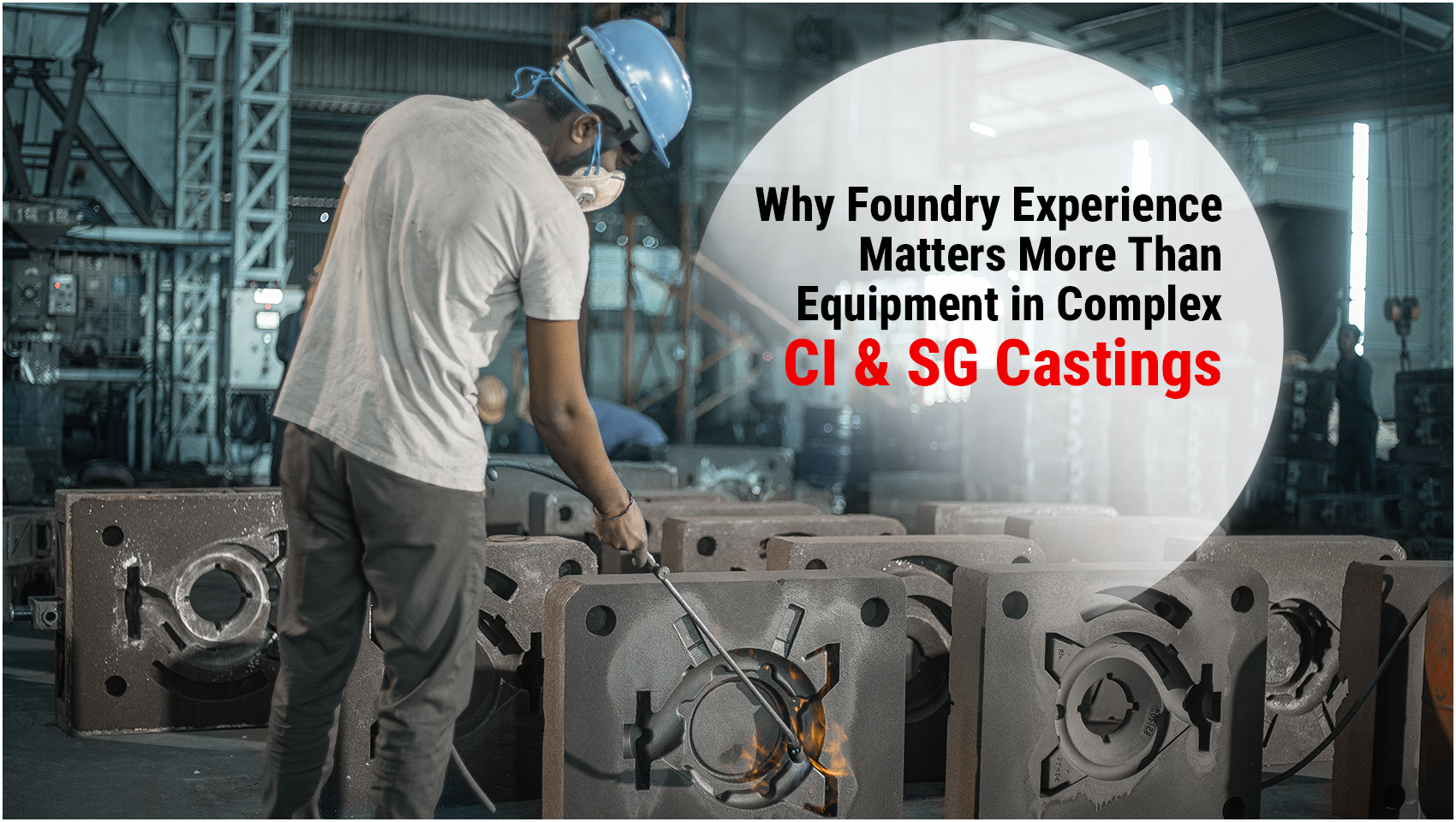
In today’s manufacturing world, foundries proudly showcase advanced molding lines, automated pouring systems, and high capacity induction furnaces. While modern equipment certainly plays an important role, it is experience not machinery that truly determines success in complex CI and SG castings.
Grey Cast Iron (CI) and Spheroidal Graphite (SG) Iron components are unforgiving. Minor process deviations can result in shrinkage defects, graphite degeneration, internal stresses, or inconsistent mechanical properties. When castings are complex in shape, heavy in section, or required to meet strict performance standards, the judgment and know-how of experienced foundry professionals become irreplaceable.
At Sagar Foundry, decades of hands-on casting experience have proven that technology supports expertise but never replaces it.
Any foundry with sufficient investment can purchase advanced machinery. Automated molding lines, spectrometers, and high efficiency furnaces are readily available across the industry. However, knowing how to use that equipment correctly across varying casting challenges is where experience separates average foundries from reliable ones.
Experienced foundry engineers understand:
These insights are not programmable. They come only from solving real world casting problems repeatedly.
Complex castings introduce multiple risks: uneven cooling, internal porosity, graphite structure variation, and residual stress buildup. No machine can independently decide how to adjust gating ratios, feeder placement, or pouring temperature for a unique casting geometry.
Experienced foundries think beyond standard process settings.
At Sagar Foundry, process decisions are based on:
This ability to adapt processes intelligently is the difference between repeat rejections and consistent approvals.
SG iron (ductile iron) is far more sensitive than grey iron. Graphite nodularity, magnesium recovery, and melt treatment timing must be controlled precisely. Even with advanced equipment, one small misjudgement can compromise the entire batch.
Experienced foundry teams know:
These decisions often happen in seconds on the foundry floor something no automated system can replicate.
Modern equipment helps detect defects, but experienced foundries prevent them before they occur.
Through years of production, seasoned engineers develop a mental library of defect patterns:
This pattern recognition allows experienced foundries like Sagar Foundry to adjust processes proactively saving time, cost, and client frustration.
When a casting fails inspection, equipment does not analyse root causes people do. Problem solving in CI and SG casting requires deep metallurgical understanding and practical reasoning.
Experienced foundry professionals:
This consultative approach transforms a foundry from a supplier into a manufacturing partner.
Automation improves repeatability, but consistency over years and across multiple part types depends on process discipline, which is built through experience.
At Sagar Foundry:
This culture of continuous improvement ensures reliable quality, not just impressive machinery.
Complex CI and SG castings often serve critical applications: machinery housings, automotive components, infrastructure parts, and agricultural equipment. These clients demand more than dimensional accuracy.
They expect:
Meeting these expectations requires experience in interpreting drawings, applications, and real world usage not just following specifications blindly.
While advanced equipment improves efficiency, experience reduces total project cost. Fewer trials, fewer rejections, optimized material usage, and faster approvals all come from informed decision making.
An experienced foundry:
This long term value is far more impactful than short term automation advantages.
Modern foundry equipment is essential, but it is only a tool. In complex CI and SG castings, the true differentiator is experience. It guides decisions, prevents defects, ensures consistency, and builds trust with clients.
At Sagar Foundry, years of practical casting expertise, metallurgical understanding, and problem solving capability drive every project. Equipment supports the process but experience delivers the results.
When castings are complex and expectations are high, experience matters more than machines.