Feb 09, 2026


Contact us today to discuss your requirements and discover how we can add value to your business.
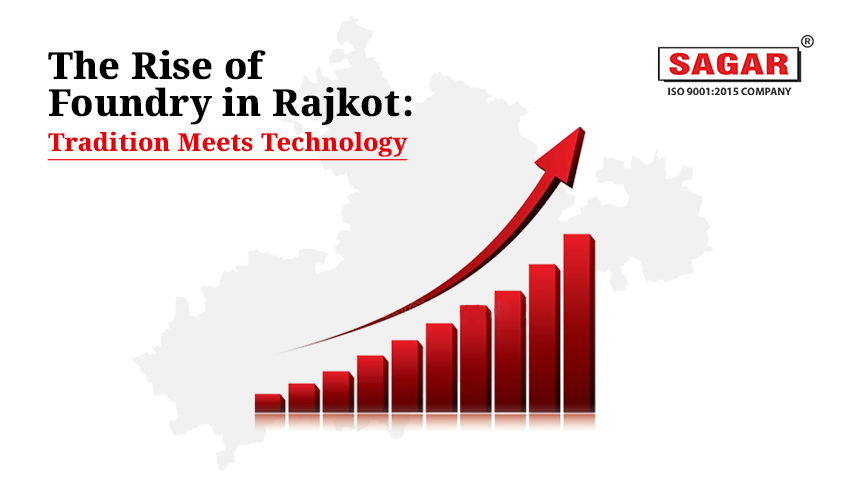
Rajkot has emerged as India’s foundry capital, blending age old casting craftsmanship with the modern touch of cutting edge innovations. At Sagar Foundry, this evolution fuels the production of CI and SG iron castings at 4300 MT per month to power the industries nationwide.
The foundry journey of Rajkot traced back to the early 20th century, when skilled artisans from Saurashtra mastered sand casting for tools and utensils. By the 1970s, family run unit Sagar Foundry, which was set up by Shri Ramjibhai Raghavjibhai Undhad, scaled up to produce industrial castings amid Gujarat’s manufacturing boom.
Today, more than 800 foundries are sprinkled over Rajkot, accounting for 40% of India’s cast iron production. This is a classic cluster with shared knowledge, from pattern making to finishing, converting raw scrap into precisely engineered pieces for pumps and valves.
These hubs are set up in local markets like Aji GIDC, where second generation leaders such as Pankaj and Ramesh Undhad expanded operations with diversified products in 2010.
Foundry work in Rajkot is based on very traditional techniques; casting methods such as green sand molding and no bake processes are followed. Craftsmen at Rajkot make wooden patterns, pack silica sand around the pattern, and pour molten iron at 1400°C, depending on eye judgment to achieve perfect pours.
These techniques shine in Sagar Foundry’s open flask casting, assuring as high as 0.5mm dimensional accuracy for weights from grams to tons. Gray iron has graphite flakes that provide natural lubrication, ideal for machine beds. Manual fettling ensures smooth finishes without power tools.
This level of hands on mastery reduces defects and draws in clients who want reliability at the beginning stage of prototyping, rather than looking to the masses for automation.
Upgradations in the foundries of Rajkot started after 2000 with digital upgradations. Sagar Foundry integrates induction furnaces, ensuring accurate melting, saving energy consumption by 30% over coal use methods, and controlling uniform SG iron nodules for better ductility.
Fully integrated 3D scanning and CAD programs have made design with complex patterns feasible in a fraction of the time; what used to take weeks sometimes takes only days. Spectrometers analyze the alloy chemistry in real time, thus allowing for grades to include EN-GJS-500-7 in ISO 9001 standards.
Automation comes in the form of robotic ladles and vibratory shakeouts that have increased throughput without cutting jobs; Rajkot employs 50,000 in this industry, marrying technology and tradition.
Ever since its inception in 1975, Sagar Foundry exemplifies this blend. Heirs have modernized the setup with automated core shooters for hollow parts but retain artisan oversight for intricate hydraulics castings.
Strategic expansions have expanded our capacity to 4300 MT by adding SG iron lines in the 1990s and no bake molding for large agricultural housings. Client testimonials show this balanced need: praise for detail on automotive gears balances on time delivery of high volume runs.
Collaborations with the Metal casting Association of Rajkot enable joint research and development, such as low phosphorus melts for corrosion resistance.
Rajkot’s foundry ecosystem generates ₹15,000 crore annually, exporting to 50 countries. Incentives such as the Gujarat Foundry Policy by the government provide for subsidies on green technology, thus inspiring ₹500 crore of investments in electric arc furnaces.
This growth has unleashed a virtuous cycle: proximity cuts logistics costs by 20%, engendering specialization. Rajkot dominates in pump impellers with 60% market share and tractor brackets.
Sagar Foundry leverages this, serving agriculture to engineering, with exports rising 25% yearly through consistent quality.
Conventional foundries are facing pollution norms. Rajkot shifted to bag filters and zero discharge plants, thus overcoming the issue; 70% compliance is targeted by 2025. Skill gaps prompt ITIs to train 5,000 youth every year in CAD and metallurgy.
With emerging technology such as 3D metal printing prototypes at Sagar Foundry, this complements the production of sand casting for low volume runs, while AI powered defect detection via X rays promises 99% yield rates.
The hybrid materials are targeting high wear applications such as earth movers, positioning Rajkot globally to produce austempered ductile iron.
Rajkot foundries feed OEMs such as Cummins and Tata, while exports of SG iron reach 100,000 tons a year. Sagar Foundry does rigorous testing: tensile, hardness, ultrasonic so that parts can withstand 10^6 cycles.
Sustainability drives change: over 90% scrap recycling rates; solar powered melting reduces CO2 by 15%. Community programs provide training for women in finishing and enhance inclusivity.
It is Rajkot’s juggernaut rise: resilient entrepreneurs married guru shishya traditions with Industry 4.0 tools. The cost advantages 20% below China paired with quick iterations make it unbeatable.
Sagar Foundry is another name for perfection; that’s from humble CI castings in 1975 to this technology savvy output.