Feb 09, 2026


Contact us today to discuss your requirements and discover how we can add value to your business.
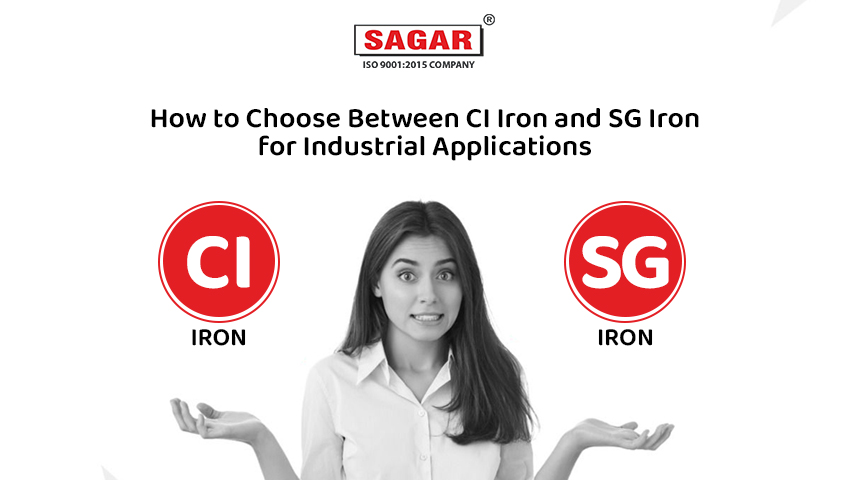
Many types of materials exist for use in industrial applications, and engineers/makers continue to evaluate materials based on their performance characteristics i.e., load capacity, strength, durability cost, and so on. For example, when comparing CI Iron (Cast Iron) and SG Iron (Spheroidal Graphite) or Ductile Iron with SG Castings, both types of metals are used in the production of industrial components, but the differing characteristics of these metals will produce different performance results based on what the application requires of them.
Sagar Foundry manufactures GR Castings and GR Iron Casting to a high standard and has extensive experience supplying to many different industrial sectors including: automotive, agricultural and construction industries; rail transport; machinery manufacturing; and infrastructure. This article provides an overview of some of the major differences between GR and GR Iron, allowing you to make an informed decision on which material is right for your application.
CI Casting is widely known for its excellent castability, machinability, vibration damping ability, and cost effectiveness. It contains graphite flakes within its structure, which contribute to its brittleness but provide natural lubrication and high compressive strength.
Key Properties of CI Iron
Where CI Casting Performs Best
If your requirement involves components subjected to compression, stability, vibration absorption, and accurate machining, CI Casting is often the ideal choice.
SG Iron, or Ductile Iron (SG Castings), has a structure in which there are rounded graphite nodules instead of graphite flakes. This gives it greater ductile (flexibility), tensile strength, and better impact resistance than other forms of cast iron. This makes SG Iron ideal for harsh environments where these qualities are required.
Properties of SG Iron:
Applications of SG Iron:
SG Iron is the preferred material for applications requiring high strengths, flexibility, and shock or repetitive stress resistance; therefore, if your application calls for these characteristics, use SG Iron.
The most noticeable distinction between CI (Cast Iron) and SG Iron (Ductile Iron) is in how the graphite within the material is formed. In CI the graphite takes the form of large flakes, making it a much more brittle material while with SG the graphite is formed in small spherical or nodular shape giving the material much greater ductility and flexibility. With respect to strength, CI has a very high compressive strength which makes it an ideal material for those components which are under constant pressure. However, SG Iron has a significantly greater tensile strength and fatigue strength, allowing it to withstand dynamic loads and cyclic stresses without failure.
Impact resistance is another area where CI and SG differ greatly; CI is much more brittle therefore it has a lower capacity to absorb shock, while SG has a very high capacity for impact resistance, allowing it to be used in heavy duty and safety critical applications. With regard to machinability, CI is more machine friendly than SG; however, SG is more difficult to machine due to its tougher composition.
Vibration damping properties of Cast Iron (CI) make it suitable for machine bases and parts that need stability and noise reduction. However, while SG Iron has moderate vibration damping while providing superior performance of CI for vibrating environments where loads and stresses vary. SG Iron is also more costly than CI because CI is typically the most cost effective option available for projects that are sensitive to costs; however, for projects exposed to high shocks, stress, and heavy loading conditions, the cost benefit of CI can be negligible in terms of mechanical performance when compared with SG Iron.
Selecting between CI Iron and SG Iron depends on your operational environment and performance needs. Here are key factors to consider:
1. Mechanical Strength Requirements
2. Cost vs Performance
3. Machining and Manufacturing Needs
4. Safety & Reliability
For automotive, railway, and pressure handling systems where failure is not acceptable, SG casting is the safer choice.
5. Operating Environment
When to opt for SG Iron as your combat includes:
SG Iron is predominantly used within the Automotive, Agricultural, Oil & Gas, Construction Equipment, Municipal Utility, and Rail Industries.
Choose CI Casting when your focus is:
The Sagar Foundry manufactures CI Casting and SG Iron Casting to fulfil customer demands along, with adhering to prevailing industry standards, mechanical properties and practical performance benchmarks.
Sagar Foundry collaborates with clients to assess their application design, load requirements and working conditions assisting them in choosing the material suited for each specific application.
By leveraging our knowledge and sophisticated molding technologies combined with quality assurance protocols we consistently manufacture robust precisely crafted castings, for industrial uses in India and regions worldwide.
In summary CI Iron and SG Iron are elements in industrial manufacturing. Selecting the material for your application relies on the usage load circumstances and the environmental context in which your product is intended to function. Typically, CI Casting is more cost effective and suitable, for load scenarios while SG Iron Casting provides enhanced durability, adaptability and safety in demanding operational environments.
If you need assistance determining whether you should utilize CI or SG iron in your application, please contact our engineering team to find out more about making the most informed choice to maximize performance and reliability for your parts.