Apr 24, 2026


Contact us today to discuss your requirements and discover how we can add value to your business.
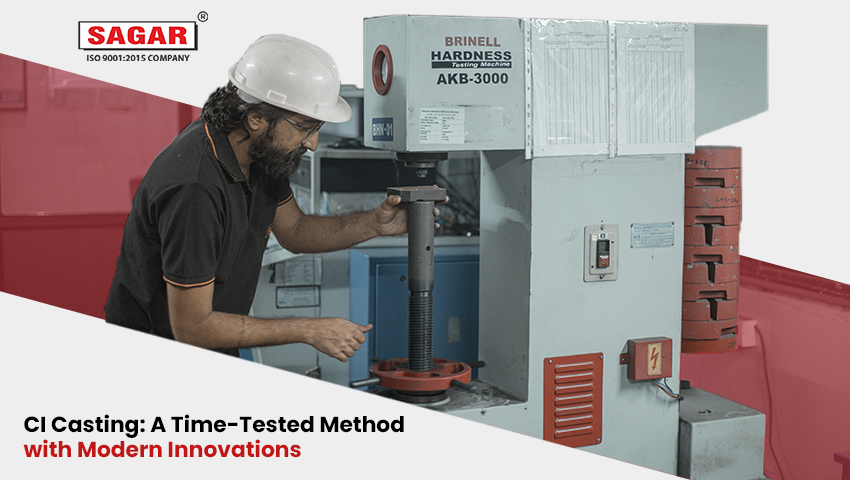
For centuries CI castings have ranked as some of the reliable and widely used industrial production methods due to their strength, efficiency and adaptability playing a crucial role in both historic engineering projects and contemporary industrial machinery. Despite the progress in technology and the ongoing creation of new materials and fabrication techniques CI remains a trusted and cost effective option, for manufacturers aiming to fulfil their production requirements.
At Sagar Foundry, we utilize CI Casting’s historical advantages and combine them with current engineering technology so that our customers receive precision cast parts that are designed specifically for their ever increasingly diverse manufacturing requirements worldwide. In this article, we will explore how CI Casting’s historical performance characteristics remain relevant in today’s marketplace and how CI Casting continues to advance through technological upgrades to prepare for future manufacturing applications.
In CI Casting the metal, is melted down and then poured into a mold which creates complex shaped durable components of varying sizes. The internal structure of the cast iron has flakes of graphitic carbon making it a naturally self lubricating material that also possesses good machinability, excellent standing vibration dampening characteristics.
What are the key benefits of CI Castings?
Due to these benefits CI Castings can be used/scoped within multiple component types such as: Machine Beds, Housings, Pipes, Engine Blocks, and Heavy Industrial Equipment.
Throughout many centuries Cast Iron has remained one of the preferred materials because it has both mechanical dependability as well as simplicity when it comes to manufacturing. In comparison to many other modern materials, Cast Iron is the material that provides an excellent combination of performance, production speed and cost effectiveness. Industries like to use it because they can be assured that CI castings will withstand the most demanding compressive loads as well as maintain dimensional stability and run efficiently with very little vibration or excessive heat.
Examples of Machine Tool Frames, Pump Housings, Construction Equipment, Power Transmission Components all rely heavily on CI castings because they can rely on their long term life and performance in conditions that otherwise would have a negative effect on other materials.
Although CI casting employs materials such as copper and iron technological progress in the past ten years has enhanced CI castings precision and adaptability enabling firms, like Sagar Foundry to develop innovative higher performance and more dependable castings.
1. Advanced Molding Processes
Contemporary sophisticated molding techniques (such as pressure molded patterns and automated sand handling methods) enable foundries to attain enhanced dimensional precision and consistency, across all parts produced by these methods. Moreover minimizing casting flaws enhances the uniformity of the characteristics of the cast components.
2. Improved Control Over Metallurgical Properties
Numerous foundries are employing automated regulation of the thermal procedures that govern the carbon and silicon content in the metal. This advancement has enabled foundries to attain enhanced mechanical qualities and consistency in their cast items guaranteeing that each casting attains the specified hardness, machinability and functional attributes.
3. Advanced Computer Aided Design and Computer Aided Manufacturing (CAD/CAM) Software and Simulation
Digital simulation tools help forecast the movement of metal as it solidifies and reduce porosity along with enhancing the gate systems to manufacturing the component. Sagar Foundry employs these modeling techniques to fabricate castings with minimal material loss and to achieve castings of greater quality, than previously.
4. Precision Surface Finishing and Machining
The finishing and machining tools at Modern Sagar Foundry (including shot blast systems and C.N.C. Machines) enable the manufacture of CI parts, with surface quality and more precise tolerances compared to CI castings made through conventional metalworking methods. Therefore CI parts produced from castings by Sagar Foundry can deliver performance to higher cost engineered materials.
5. Environmentally Friendly and Energy Efficient Delivery of Capacitive Products
Casting technology now focuses strongly on sustainability. Reusable sand systems, energy efficient melting furnaces, and waste recycling reduce environmental impact while supporting lean manufacturing.
Despite the emergence of alloys, polymers and composite materials CI casting remains the choice, in vital industrial fields because of its dependability and cost effectiveness.
Major Industries Using CI Castings
In these applications, the vibration damping ability of cast iron makes machinery quieter and more stable, significantly extending equipment life and operational safety.
While alternatives such as steel, aluminum, and SG iron are popular in specific usages, CI casting remains unmatched for heavy, stable, and compressive load applications. For example:
Thus, when production cost, reliability, and material uniformity matter most, cast iron is often the first choice.
Sagar Foundry is an experienced manufacturer with a proven track record in providing casting solutions. Our extensive experience in manufacturing CI Castings combined with our use of advanced foundry techniques allows us to produce castings that meet your exact requirements.
Sagar Foundry Offers:
We collaborate with industries to create casting solutions that maximize the efficiency, durability, and long term performance of their products.
CI Casting continues to be an integral component of the industrial manufacturing process. CI offers a combination of strength, durability, and cost effectiveness. Advancements in technology enhance production capabilities through improved efficiency or accuracy; therefore, CI will continue its evolution into the new age of industrial production.
The Sagar Foundry has built upon the traditional CI Castings by providing the most recent technological advancements available in order to ensure that CI Castings remain one of the most valuable forms of engineering available today. Whether a customer requires CIs produced according to standard specifications or would like to have their specific need met through engineered components, Sagar Foundry has the experience to provide it.